
For buyers · Medical device sourcing
How to choose a medical device contract manufacturer
Check the FDA registration, the quality system under the new QMSR and the validation records before you compare prices. Here's what to ask for and where to look it up.
In this article
The short answer
Choose a medical device contract manufacturer on evidence, not the sales deck. Check that the plant is registered with FDA for the work it'll do for you, that its quality system meets FDA's Quality Management System Regulation (QMSR), and that it can show validation records for the processes your device needs. Then compare price and lead time.
The rules changed this year. FDA's QMSR took effect on February 2, 2026, and it incorporates ISO 13485:2016 by reference into 21 CFR Part 820. Supplier checklists built around the old Quality System Regulation section numbers are now out of date. The checks below go in the order we'd run them, with the FDA database or regulation behind each one. When you know what you need, compare medical device manufacturers in the directory.
Start with what the QMSR changed
Since February 2, 2026, 21 CFR Part 820 has required device manufacturers to document a quality management system that complies with ISO 13485:2016 plus FDA's own added requirements, such as unique device identification under Part 830 and complaint reporting under Part 803.
Three things follow for a buyer. First, ISO 13485 is now the base of the US rule, but FDA said in the final rule that "compliance only with ISO 13485 does not fully satisfy the QMSR." Second, FDA's QMSR FAQ says FDA won't require or issue ISO 13485 certificates, and a certificate "will not exempt a manufacturer from an FDA inspection." Third, FDA stopped using its old QSIT inspection technique and now inspects under compliance program 7382.850. The FAQ also says the QMSR lets FDA inspect management review, quality audits and supplier audit reports. So a candidate that still talks only in old section numbers, or can't tell you when it updated its procedures, hasn't finished the move.
Practical takeaway: Ask each candidate when they moved their procedures to the QMSR and how their quality manual maps to ISO 13485 clauses.
Look up the FDA registration and device listing
A contract manufacturer that makes a finished device to another company's specifications has to register and list under 21 CFR 807.20(a)(2). FDA's who must register table marks contract manufacturers yes for registration, listing and the fee.
Check it yourself in FDA's Establishment Registration & Device Listing database. You can search by establishment name, owner or operator, registration or FEI number, product code, establishment type and US state. Open the record and look at the establishment types and the devices listed for that site. Compare the address with the plant that'll build your device, because registration is by establishment, not by company. Two limits. FDA says the listing "does not in any way denote approval of the establishment or its products," and the data is generally updated weekly, so a new registration may not show yet. And a maker of components only isn't required to register under 21 CFR 807.65(a), so a missing record means less for a component supplier than for the plant building your finished device.
Practical takeaway: Search the FDA database for the plant itself, check the address, and save a dated copy of the record.
Verify the ISO 13485 certificate and read the scope
FDA doesn't require an ISO 13485 certificate, but if a candidate has one it's still a useful check. Verify it with the certification body that issued it and read the scope line: which site, which processes, which product types.
Our certification verification guide shows how to check a certificate in IAF CertSearch and with the certification body's own records. Watch for a certificate that covers a different site from the one quoting you, or a scope that only mentions, say, machining of components when you need finished-device assembly, packaging and labeling. If you want to read ISO 13485 itself before an audit, FDA's QMSR training slides point to a read-only copy on ANSI's incorporation by reference portal. And keep the certificate in proportion. It's a third party's opinion on a date, and the QMSR FAQ is clear that it doesn't exempt a manufacturer from FDA inspection.
Practical takeaway: Match the certificate's site address and scope wording to the exact work you're outsourcing.
Agree who owns the design, then plan design transfer
Under 21 CFR 820.10(c), class II and class III devices, plus some class I devices, have to meet ISO 13485's design and development clause 7.3. Decide in writing whether you or the contract manufacturer owns that work.
The company that writes the specifications has duties too: 21 CFR 807.20(a)(1) brings anyone who "initiates or develops specifications for a device that is to be manufactured by a second party" into the registration requirement. The hand-off point is design transfer. FDA's QMSR design and development training sums up ISO 13485 clause 7.3.8 like this: document procedures for transferring design outputs to manufacturing, verify the outputs are suitable for manufacturing before they become final production specifications, and confirm production capability can meet the device requirements. Ask the contract manufacturer to walk you through a redacted transfer it has done: the transfer plan, the specifications released to production, the pilot build results and who signed off. If it'll also do design work for you, ask how design changes are controlled once production starts. Clause 7.3.9 covers changes.
Practical takeaway: Write the design owner, the transfer deliverables and the sign-off names into the contract before the pilot build.
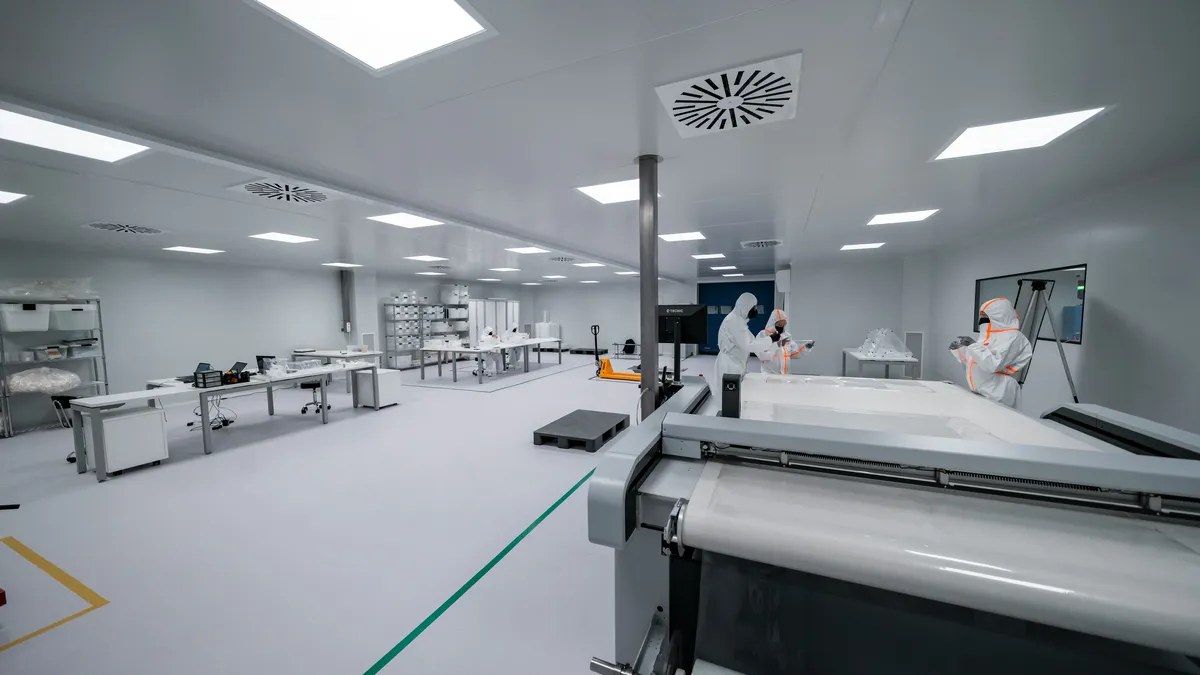
Match the cleanroom to the product
If your device needs a controlled environment, ask for the room's ISO class and its latest classification report. ISO 14644-1:2015 classifies air cleanliness by the concentration of airborne particles from 0.1 to 5 µm, and FDA recognizes the complete standard.
The class you need comes from your device requirements and risk analysis, not from a brochure. Buy the class your requirements call for and check that the room delivers it. Ask which operations happen inside the classified area and which happen outside it, for example whether final packaging is done in the room or on an open bench. Ask how often the room is monitored and what happens when a count goes over the limit. Also note what the standard doesn't do. FDA's recognition record says ISO 14644-1 can't be used to characterize the physical, chemical or biological nature of the particles, so microbial control is a separate conversation. If your device is sold sterile, ask about sterilization separately, including who validates it.
Practical takeaway: Ask for the classification report and monitoring records for the room your device will actually be built in.
Ask for validation evidence: IQ, OQ and PQ
A process has to be validated when its output can't be fully verified by later inspection and test. That's how FDA's CDRH Learn process validation module puts it, using injection molding and heat sealing as examples, and it's the first question to ask about every process your device goes through.
The module describes the stages plainly. Installation qualification (IQ) checks that the equipment is installed correctly, including utilities. Operational qualification (OQ) challenges the process and its parameters to set the control limits. Performance qualification (PQ) runs the process under normal manufacturing conditions with trained staff, and the module suggests covering different operators, lines and shifts. The module dates from 2017. It names the 2004 GHTF process validation guidance as the most current device resource and refers to the old 820.75. Under the QMSR, FDA's risk training slides place validation in ISO 13485's production clause 7.5. Ask for the validation master plan, the protocols and reports for your processes, and what triggers revalidation. A process that's "been run for years" isn't validated unless the reports exist.
Practical takeaway: Request the IQ, OQ and PQ reports for each process your device needs, not just the validation procedure.
Put the split of duties in a quality agreement
FDA's QMSR risk slides point to ISO 13485 clauses 4.1.5 and 7.4: controls over outsourced processes in proportion to the risk and the supplier's ability, supplier selection criteria in proportion to device risk, and verification of purchased product based on how the supplier was evaluated.
If you're the manufacturer of record, that's your side of the relationship, and a written quality agreement is where the controls live. Our suggested contents: who keeps the medical device file and design files; which changes need your approval before they happen, and the notice period; who handles complaints and who reports to FDA under Part 803, which 21 CFR 820.10(b)(3) ties to ISO 13485 clause 8.2.3; nonconforming product and corrective action duties; record retention; your right to audit, including for-cause audits; rules for the contract manufacturer's own subcontractors; and how advisory notices and recalls are handled under Part 806. Have your regulatory lead review the draft. And since the QMSR FAQ says FDA can inspect supplier audit reports, write your audit reports so an investigator could follow them.
Practical takeaway: Draft the quality agreement before the first purchase order, not after the first nonconformance.
What to send in your RFQ
Send the device description and FDA class, drawings and specifications, the bill of materials, annual volume and first-order quantity, and the steps you want quoted: components, assembly, packaging, labeling, sterilization or a mix.
Add what's already done and what isn't: which design verification and process validation exists, and what's left. Say whether you need cleanroom assembly and which standards your device file already cites. Include a draft quality agreement, or at least a list of what it'll cover, so the quote reflects the documentation work and not only the parts. Ask each candidate to send back its FDA registration number, its ISO 13485 certificate number and certification body if it has one, and the class of the room it would use. You can check all three in public records before the first call. Our manufacturing RFQ guide covers the file package and how to compare quotes. Then shortlist from medical device manufacturers or, for instruments, surgical instrument manufacturers. A directory listing isn't proof of registration or certification, so run the checks above on every name.
Practical takeaway: Ask every candidate to return their FDA registration number and certificate details with the quote so you can check them the same day.
Frequently asked questions
Does a medical device contract manufacturer need ISO 13485 certification?
- Not for FDA. FDA's QMSR FAQ says it won't require or issue ISO 13485 certificates. The QMSR does require a quality system that complies with ISO 13485:2016 plus FDA's added requirements, and a certificate doesn't exempt anyone from inspection. Your own customers may still ask for one.
Does a contract manufacturer have to register with the FDA?
- Yes, if it makes a finished device to another company's specifications. 21 CFR 807.20(a)(2) covers it, and FDA's registration table marks contract manufacturers yes for registration, listing and the fee. Makers of components only are exempt under 807.65(a).
How do I look up a manufacturer's FDA registration?
- Use FDA's Establishment Registration & Device Listing database on accessdata.fda.gov. Search by establishment name, registration or FEI number, or product code, then check that the address and listed devices match the plant you're hiring.
Does FDA registration mean the FDA approved the manufacturer?
- No. FDA's database says registration "does not in any way denote approval of the establishment or its products by FDA." It tells you the site has told FDA what it does. It isn't a quality rating.
What is the QMSR and when did it take effect?
- The Quality Management System Regulation is FDA's amended 21 CFR Part 820. It took effect on February 2, 2026. It incorporates ISO 13485:2016 by reference and adds some FDA-specific requirements, such as unique device identification and complaint reporting.
What's the difference between IQ, OQ and PQ?
- IQ shows the equipment is installed correctly. OQ challenges the process settings to find the limits that give good product. PQ runs the process under normal production conditions to show it does that consistently. Ask for the reports, not just the procedure.
What cleanroom class do I need for medical device assembly?
- It depends on your device and your risk analysis. There isn't one class for all devices. ISO 14644-1 defines the classes by airborne particle concentration. Decide the class from your requirements, then ask for the room's latest classification report.
Who is responsible for FDA compliance, me or the contract manufacturer?
- Usually both, for different things. Part 807 covers the company that develops the specifications and the one that makes the device, and Part 820 counts specification developers as manufacturers. Write the split into a quality agreement and have your regulatory lead review it.
Sources
The pages this guide cites, in the order they appear.
- QMSR · fda.gov
- 21 CFR Part 820 · ecfr.gov
- final rule · fda.gov
- QMSR FAQ · fda.gov
- 21 CFR 807.20(a)(2) · ecfr.gov
- who must register table · fda.gov
- Establishment Registration & Device Listing database · accessdata.fda.gov
- 21 CFR 807.65(a) · ecfr.gov
- ANSI's incorporation by reference portal · ibr.ansi.org
- 21 CFR 820.10(c) · ecfr.gov
- QMSR design and development training · fda.gov
- ISO 14644-1:2015 · accessdata.fda.gov
- CDRH Learn process validation module · fda.gov
- risk training slides · fda.gov